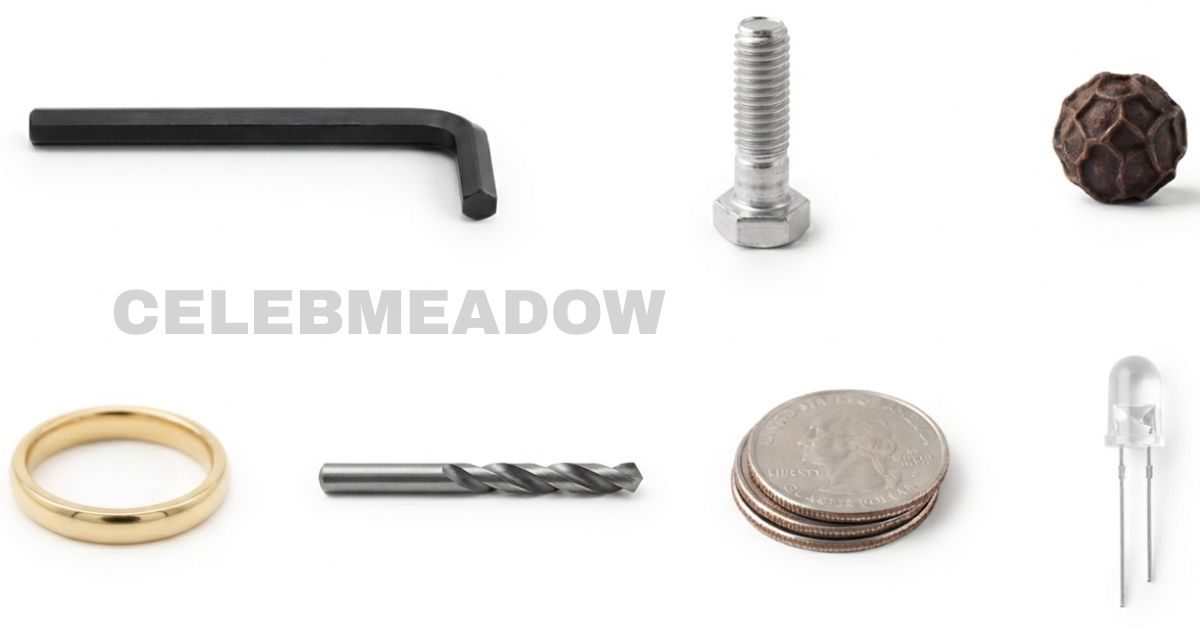
You ordered a replacement part online. The spec sheet says 5mm. Now you’re standing there wondering if that’s smaller than you think — or bigger. 5mm is roughly 0.2 inches, which is 0.016 feet, or exactly 0.5 cm. It’s a genuinely small measurement — smaller than your pinky fingernail width, but bigger than a sesame seed. This guide shows you 15 real objects that are 5mm in size so you can picture it clearly and make the right call.
How big is 5mm? Quick Conversion Guide
| Unit | Value |
| Millimeters | 5 mm |
| Centimeters | 0.5 cm |
| Meters | 0.005 m |
| Inches | 0.197 in |
| Feet | 0.016 ft |
15 Common Things That Are 5mm Big
| Object | Category | Measurement | Which Part Measured | Exact or Approximate |
| Standard 5mm LED Lens | Electronics | 5.0 mm | Outer lens diameter | Exact |
| Metric Graph Paper Square | Stationery | 5.0 mm | Side length of one grid square | Exact |
| Mechanical Pencil Eraser Refill | Stationery | 5.0 mm | Cross-sectional diameter | Exact |
| Tactile Switch Cap | Electronics | 5.0 mm | Total height | Exact |
| Stack of 3 US Quarters | Currency | ~5.25 mm | Combined thickness | Approximate |
| #5 Zipper Teeth (Closed) | Textiles | ~5.5 mm | Width across teeth | Approximate |
| Yoga / Fitness Mat | Fitness | 5.0 mm | Thickness | Exact |
| Felt Furniture Protector Pad | Hardware | 5.0 mm | Uncompressed thickness | Exact |
| Wedding Ring Band | Jewelry | ~5.0 mm | Band width | Approximate |
| Short-Grain White Rice (uncooked) | Food | ~5.0 mm | Grain length | Approximate |
| Tellicherry Black Peppercorn | Food/Spice | 4.5–5.0 mm | Diameter | Approximate |
| Mini Dice | Gaming | 5.0 mm | Face edge length | Exact |
| 5mm Hex Key (Allen Wrench) | Tools | 5.0 mm | Width across flats | Exact |
| M5 Threaded Bolt Shank | Hardware | 5.0 mm | Outer thread diameter | Exact |
| 5mm Twist Drill Bit | Tools | 5.0 mm | Cutting tip diameter | Exact |
1. Standard 5mm LED Lens
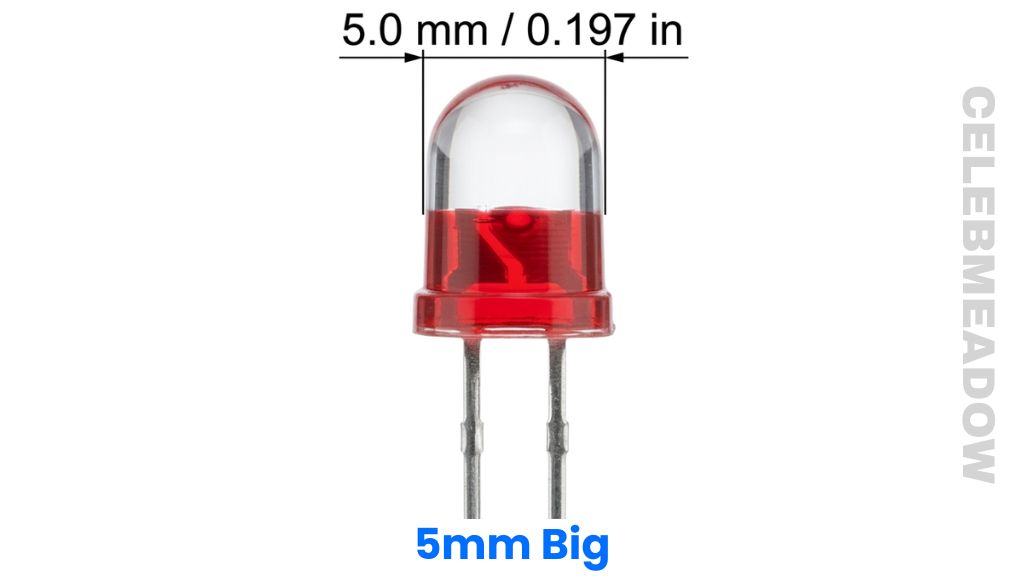
A standard 5mm LED has an outer lens diameter of exactly 5.0mm — this is a globally fixed electronics manufacturing standard.
That tiny dome-shaped tip you see glowing on power strips, toys, and circuit boards? That’s a T1-3/4 LED package, and its 5mm width exists because manufacturers worldwide agreed on one unified size. It means a hole drilled at 5mm will fit any standard indicator LED from any country.
Pick one up between your fingers and you’ll feel it — it’s barely wider than a thick toothpick head. Next time you’re drilling a mounting hole for an indicator light in a panel or enclosure, a 5mm drill bit is your starting point.
Key measurement: 5.0 mm / 0.197 in
2. Metric Graph Paper Square
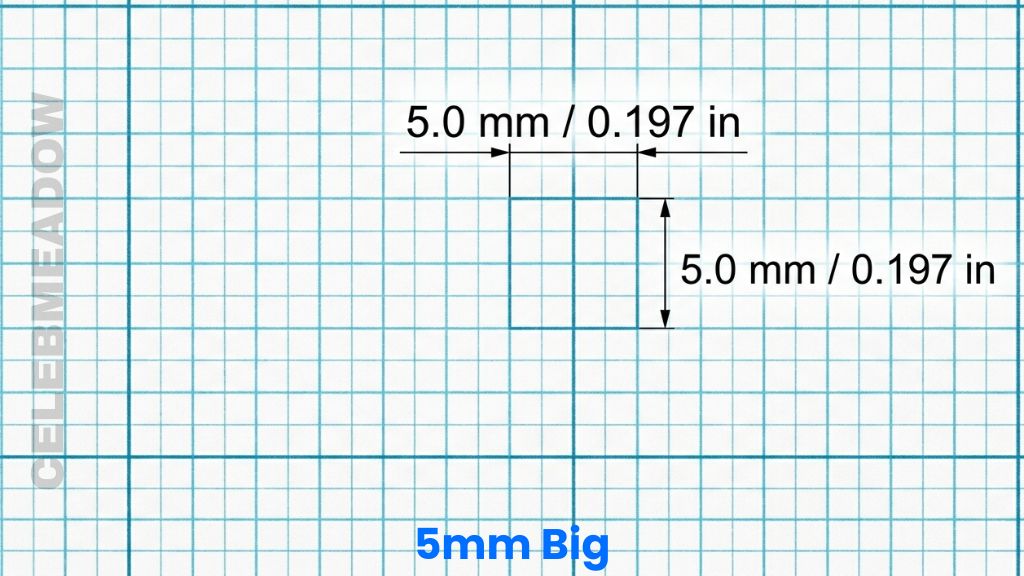
Each small square on standard metric graph paper measures exactly 5.0mm on every side.
This isn’t a random size. Metric graph paper squares are sized to work cleanly with real-world scale drawings — one square per centimeter, scaled to represent real meters on an architectural floor plan. The 5mm grid lets you sketch dimensions in your head without pulling out a ruler.
Grab a sheet right now. Place your thumbnail over one square. That square — that exact tiny box — is 5mm. It’s a fast, zero-cost way to check a 5mm measurement on the fly.
Key measurement: 5.0 mm / 0.197 in
3. Slim Mechanical Pencil Eraser Refill
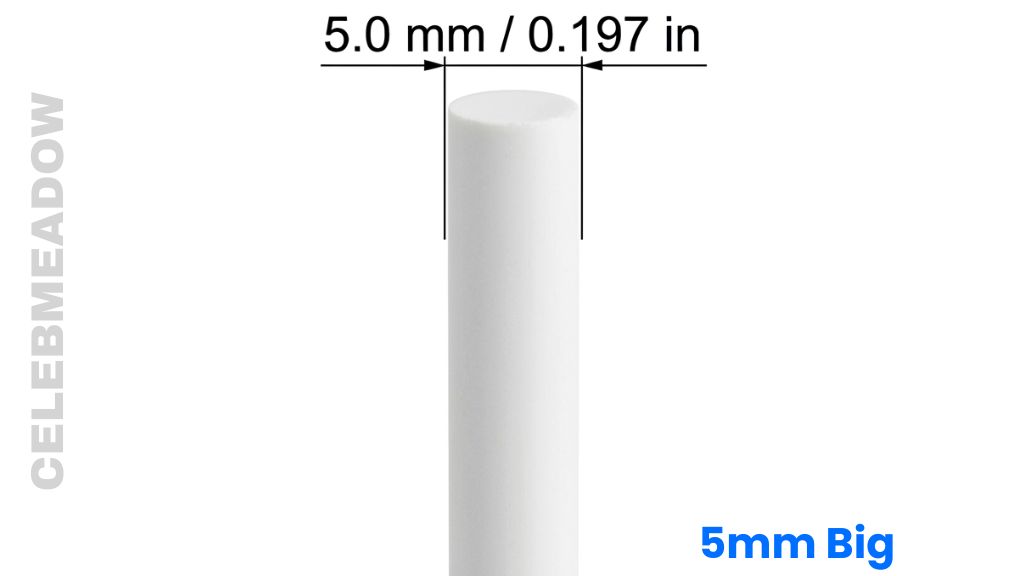
The thin white rubber cylinder inside a drafting mechanical pencil has a cross-sectional diameter of exactly 5.0mm.
Manufacturers chose this diameter because it’s narrow enough for precise corrections on technical drawings, but thick enough not to crumble or snap under normal pressure. It slides cleanly into the pencil barrel without wobbling.
Pull one out and hold it upright between two fingers. That slim rubber rod is 5mm across — a clean, tactile way to feel the measurement in your hand.
Key measurement: 5.0 mm / 0.197 in
4. Standard 5mm Tactile Switch Cap
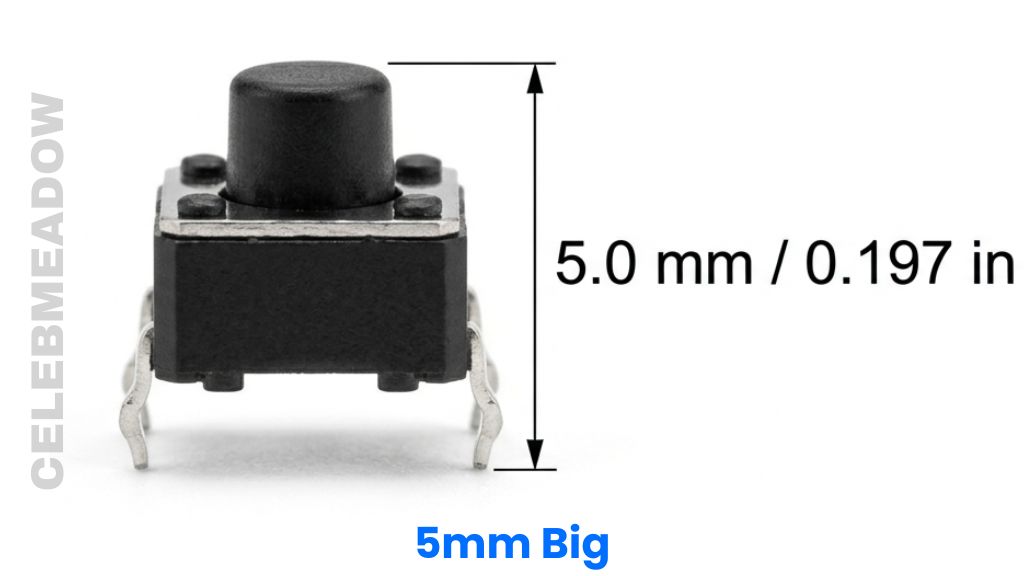
The total height of a standard push-button tactile switch — from the base to the top of the button cap — is exactly 5.0mm.
This height is calculated precisely so the button clears a thin membrane panel without protruding too far. You find these switches inside TV remotes, key fobs, keyboards, and alarm panels. They’re clicked thousands of times without ever being seen.
Crack open an old remote control and look at the circuit board. Those small square buttons sitting flush? Each one stands exactly 5mm tall. That’s the height that makes them work without jamming against the case.
Key measurement: 5.0 mm / 0.197 in
5. Stack of 3 US Quarters
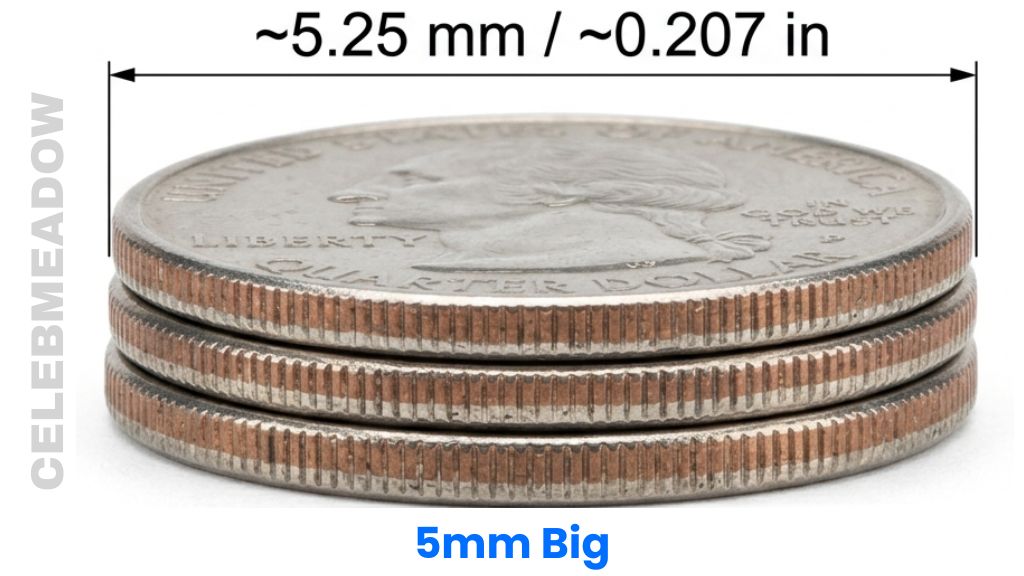
Three US quarters stacked together reach a combined thickness of commonly around 5.25mm — within a quarter-millimeter of 5mm.
US quarters are minted to extremely tight dimensional specs because vending machines and coin sorters rely on exact thickness to sort currency mechanically. Each coin is 1.75mm thick. Stack three and you’re just barely above 5mm.
No ruler? No problem. Grab three quarters and stack them. Hold the stack on its edge between your thumb and index finger. That gap — that slim column of metal — is what 5mm feels like.
Key measurement: ~5.25 mm / ~0.207 in
6. #5 Gauge Zipper Teeth (Closed)
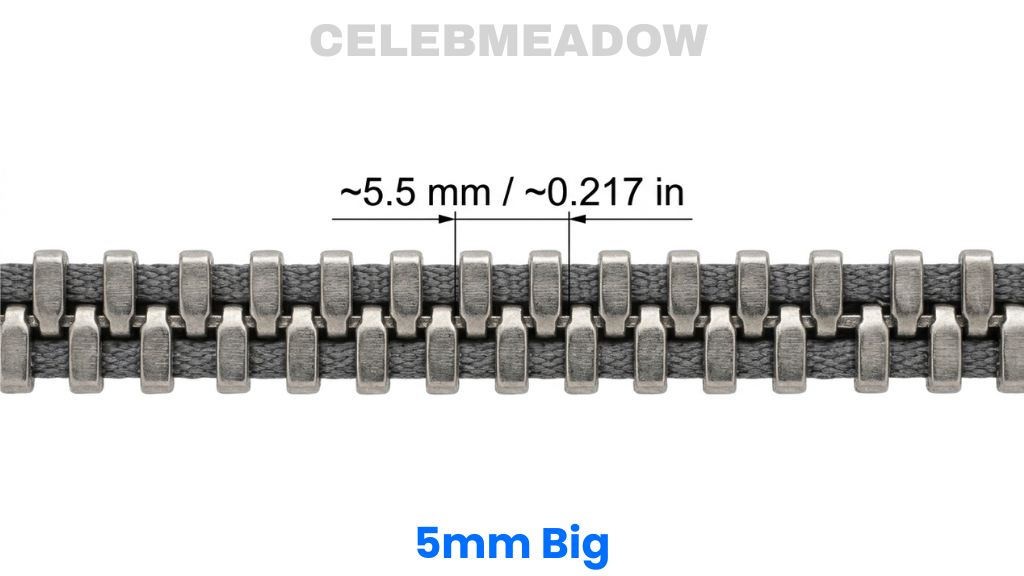
A closed #5 zipper track measures commonly around 5.5mm across the width of its interlocked teeth.
The number in a zipper’s classification — #3, #5, #8 — directly refers to the width of the closed teeth chain in millimeters. A #5 zipper is the standard choice for outdoor jackets, boots, and backpacks because it balances strength with flexibility. It’s the size most people interact with daily without realizing it.
Run your finger along the closed zipper on your jacket or bag. That ribbed track between the two fabric edges? That’s your 5mm visual reference, zipped up and ready.
Key measurement: ~5.5 mm / ~0.217 in
7. Medium-Duty Yoga / Fitness Mat

A standard medium-duty yoga or fitness mat is exactly 5.0mm thick — a deliberate balance between cushioning and stability.
Thinner mats (3mm) don’t absorb enough impact for knee-heavy exercises. Thicker ones (8mm+) make balancing poses feel wobbly. The 5mm thickness hits a practical middle ground — protective enough for hard floors, light enough to roll up and carry.
Lay your mat flat on the floor and look at it from the side. That compressed foam edge staring back at you is 5mm. It’s one of the easiest places to see this measurement in everyday life without any measuring tools.
Key measurement: 5.0 mm / 0.197 in
8. Heavy-Duty Felt Furniture Protector Pad
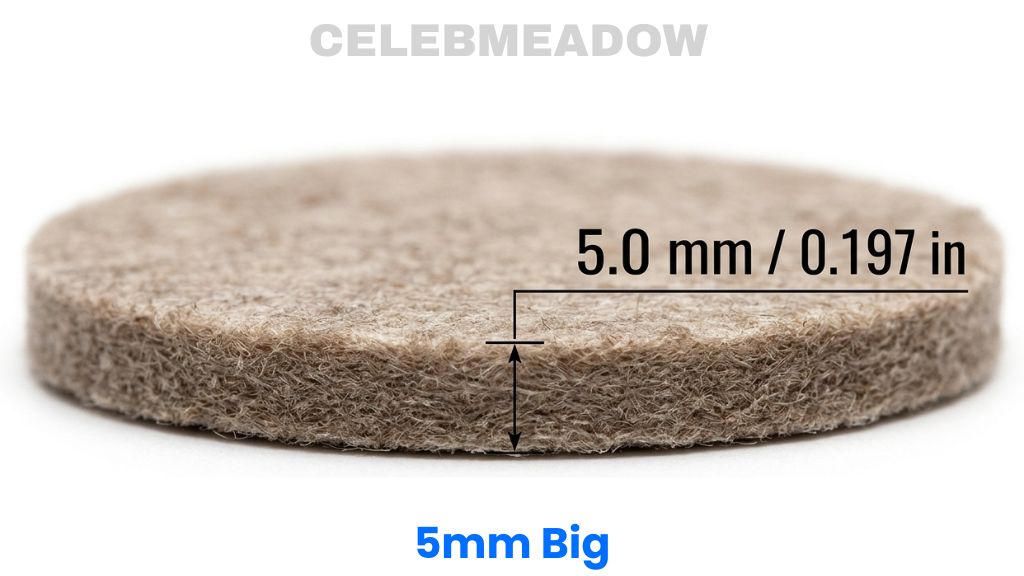
Before compression, a heavy-duty felt furniture protector pad is exactly 5.0mm thick.
That thickness matters. Too thin and the pad doesn’t absorb the scraping force of a chair leg against hardwood. Too thick and it tilts furniture on uneven floors or creates a gap under a door. The 5mm standard compresses slightly under load — enough to grip, not enough to buckle.
Before you stick one under a chair leg, pinch it between your fingers. That soft, dense disc you’re holding? That compressed stack of felt is 5mm. You can feel how it gives under your thumbnail.
Key measurement: 5.0 mm / 0.197 in
9. Wedding Ring Band Width
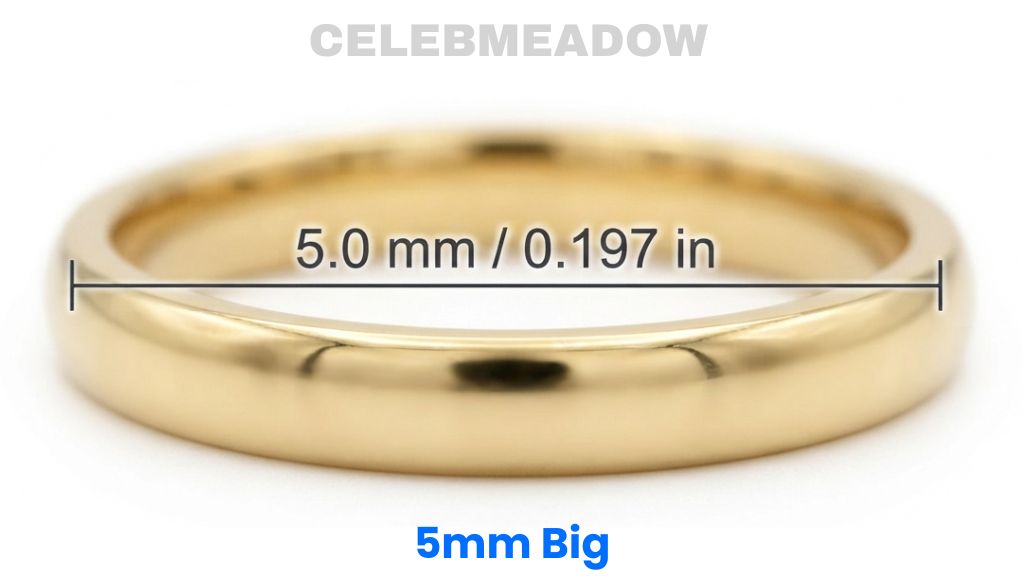
A classic wedding band commonly around 5.0mm wide is the single most popular width sold in bridal jewelry worldwide.
That width exists because it sits on the finger without overlapping the knuckle during movement, while still being visible and substantial-looking. Narrower bands (2–3mm) feel light and casual. Wider bands (7–8mm) can restrict knuckle flexibility. 5mm is where comfort and presence meet.
Look at a classic gold or silver wedding band on someone’s finger. That stripe of metal between the two edges of the ring — that visible width — is your 5mm reference.
Key measurement: ~5.0 mm / ~0.197 in
10. Uncooked Short-Grain White Rice
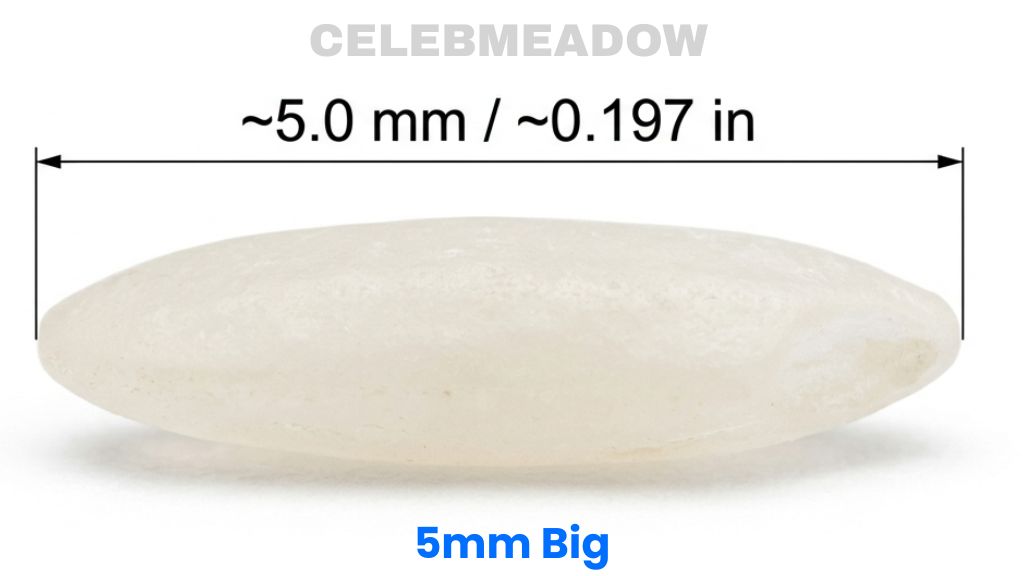
A single grain of uncooked short-grain white rice is commonly around 5.0mm long — a biological average, not an engineered spec.
Short-grain rice (the type used in sushi and risotto) grows squat and compact due to the genetics of the Oryza sativa japonica plant variety. It’s shorter and rounder than long-grain rice, which runs 6–8mm. That size difference is actually why it absorbs water and sticks together differently when cooked.
Pour a small pile of short-grain rice on your palm. Pick up one grain and look at it under light. That single grain from tip to tip is 5mm — a natural ruler you probably have in your kitchen right now.
Key measurement: ~5.0 mm / ~0.197 in
11. Large Tellicherry Black Peppercorn

A premium Tellicherry black peppercorn is typically near 4.5 to 5.0mm in diameter — graded by mechanical sieves to meet spice certification standards.
Tellicherry peppercorns are left on the vine longer than standard varieties before harvest. That extra time causes them to grow larger, develop more complex oils, and pass through a larger sieve hole during grading. The size directly signals ripeness and flavor concentration.
Open your pepper grinder and tip one peppercorn into your palm. Roll it between your fingers. That hard, wrinkled little sphere — right there — is 5mm in diameter.
Key measurement: ~4.5–5.0 mm / ~0.177–0.197 in
12. Standard Mini Dice
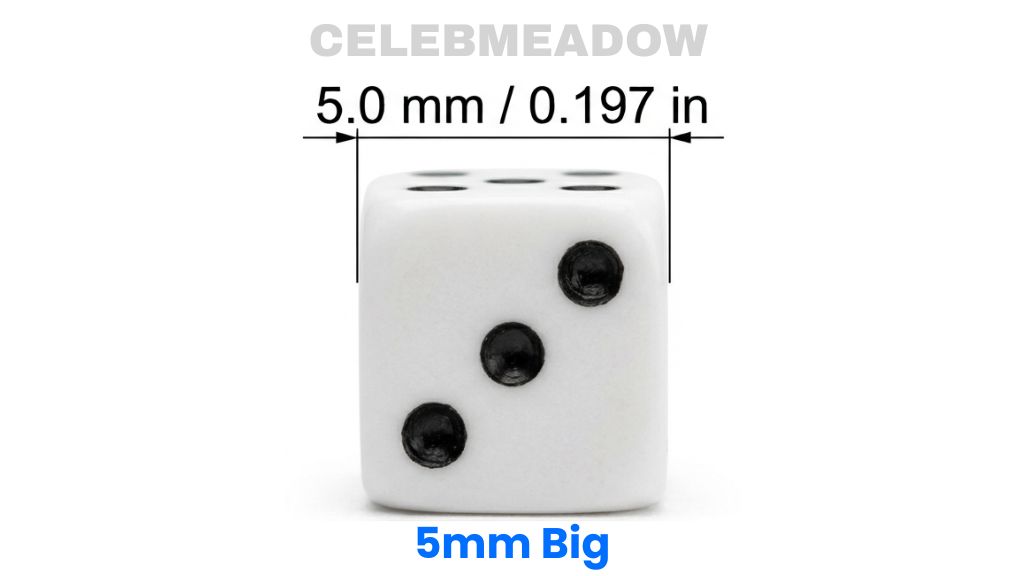
A standard mini dice has a face edge length of exactly 5.0mm — purpose-built for compact travel games and miniature tabletop setups.
Full-size gaming dice run 16mm per edge. Mini dice at 5mm are about a third of that — small enough to fit a dozen inside a tiny tin. The mold geometry is precise because fair dice require exact parallel faces, and even at 5mm, the tolerances need to be tight for unbiased rolls.
Set a mini die on your fingertip. It barely covers your fingerprint ridges. That tiny cube — each face the width of a thick grain of wheat — is exactly 5mm per edge.
Key measurement: 5.0 mm / 0.197 in
13. 5mm Metric Hex Key (Allen Wrench)
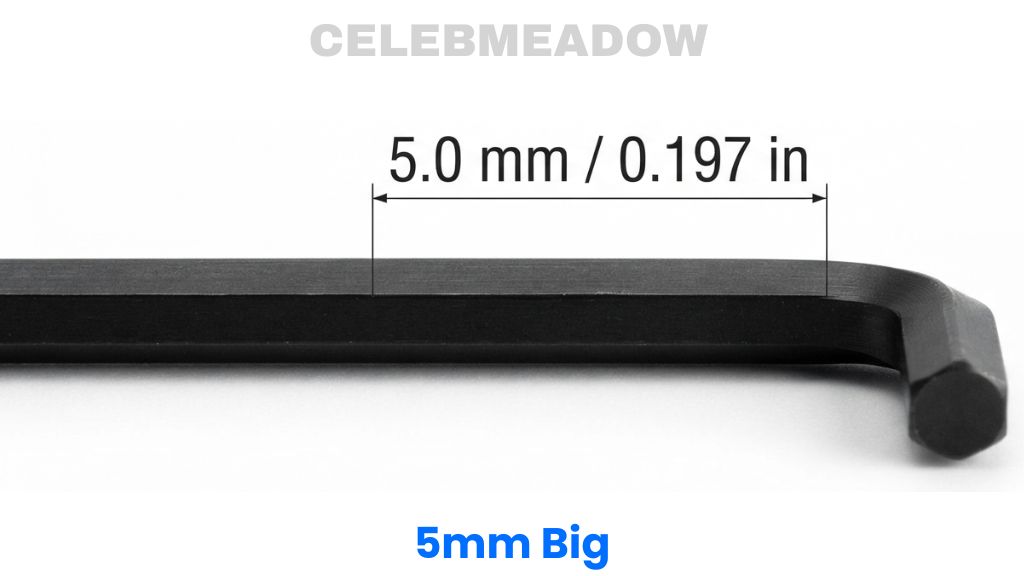
A 5mm hex key measures exactly 5.0mm across its flat sides — machined to DIN 911 / ISO 2936 tolerances.
That width isn’t chosen casually. The flat-to-flat measurement must match the socket recess in a bolt head exactly — even 0.1mm of slop can round off a socket under torque. 5mm is one of the most-used hex sizes in cycling, flat-pack furniture, and electronics mounting because M5 bolts are everywhere.
Dig through the Allen key set that came with your last piece of flat-pack furniture. The one labeled 5 — or the one that fits your bike stem — that’s your reference. Hold it and feel the width of the shaft.
Key measurement: 5.0 mm / 0.197 in
14. M5 Threaded Bolt Shank
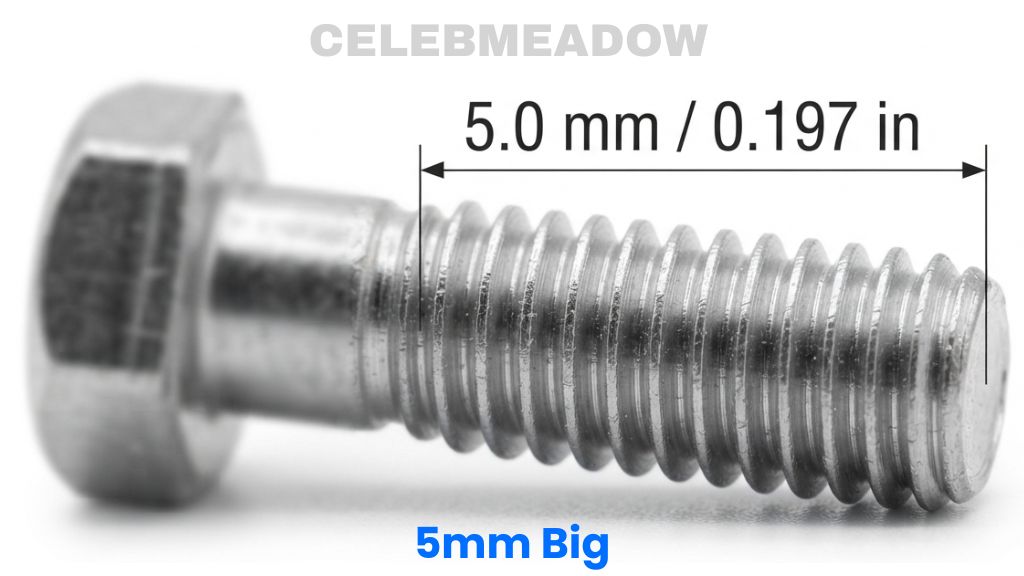
An M5 bolt has an outer thread diameter of exactly 5.0mm, defined by ISO metric screw thread standard ISO 68-1.
The “M” in M5 stands for metric, and the number is the outer diameter in millimeters. This ISO standard exists so that an M5 bolt made in Germany threads perfectly into an M5 nut made in Japan. No measuring required — the naming system does the work.
Hold an M5 bolt (the kind that comes with most monitor mounts or bicycle components) and look at the shank. That threaded cylinder is 5mm thick. Pair it with a 5mm hex key and a 5mm drill bit and you have a complete fastening system, all sharing the same dimension.
Key measurement: 5.0 mm / 0.197 in
15. 5mm Twist Drill Bit
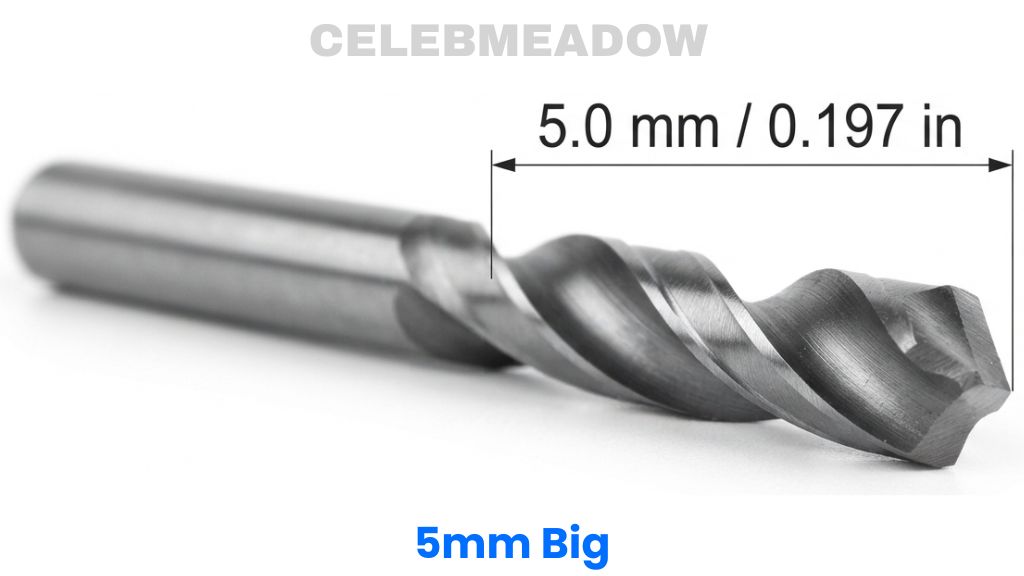
A 5mm twist drill bit cuts a hole with an outer diameter of exactly 5.0mm — the precise clearance needed for an M5 bolt to pass through cleanly.
Drill bits in the metric system step up in 0.5mm or 1mm increments. 5mm sits at a critical point: it’s the exact clearance hole size for M5 fasteners. Use it in wood, plastic, or thin metal. The hole it leaves is just wide enough for the bolt shank to slide through without binding, but tight enough to prevent wobble.
Hold a 5mm bit up to your eye and look at the tip. That fluted spiral narrows to a 5mm cutting circle — the same width as the rice grain, the LED, and the hex key you’ve already pictured.
Key measurement: 5.0 mm / 0.197 in
How to Picture 5mm Without a Ruler
The fastest method is the pinch test. Press your thumb and index finger together as if holding a very thin card. Now slide a standard credit card between them — that card is 0.76mm thick. Five of those stacked equals roughly 3.8mm. Add one more thin card and you’re at 5mm. Your fingers can learn to feel that gap with a little practice.
The second method uses coins as a stack gauge. Take three US quarters and hold the stack on its edge. That slim column of metal sits at roughly 5.25mm — a near-perfect match for 5mm. Most people carry quarters, and this trick works in any hardware store, kitchen, or workshop when you need a quick check.
There’s also a body-based shortcut. Look at your pinky fingernail. For most adults, the width of the pinky nail ranges from 8–12mm — noticeably wider than 5mm. But the thickness of your pinky fingernail itself (the nail plate, not the finger) runs 0.3–0.5mm. Stack roughly ten of those nail thicknesses and you have 5mm. It sounds odd, but once you feel it, the number clicks.
5 mm Size Compared to Similar Sizes
| Measurement | In cm | Compared to 5mm |
| 3 mm | 0.3 cm | Thinner than a credit card stack (2 cards) |
| 4 mm | 0.4 cm | Width of a standard wooden matchstick |
| 5 mm | 0.5 cm | ← You are here |
| 6 mm | 0.6 cm | Slightly wider than a standard pencil eraser refill |
| 7 mm | 0.7 cm | Close to the width of a standard pencil body |
| 10 mm | 1.0 cm | Double 5mm — about the width of a shirt button |
Common Questions About 5mm
How long is 5mm in inches?
5mm equals 0.197 inches — just under one-fifth of an inch. On a standard ruler, it falls just before the first major quarter-inch mark. If your ruler only shows inches, look for the point slightly before the ¼-inch line.
Is 5mm the same as half a centimeter?
Yes, exactly. There are 10 millimeters in one centimeter, so 5mm is precisely 0.5 cm — the halfway point between 0 and 1 centimeter on any metric ruler.
What common household object is 5mm thick?
A standard yoga mat is exactly 5mm thick, and so is a heavy-duty felt furniture pad. If you want something even smaller, a single grain of short-grain uncooked rice is commonly around 5mm long — and most people have rice in their kitchen.
How do I measure 5mm without a ruler?
Stack three US quarters on their edges. That stack reaches roughly 5.25mm — close enough for most practical estimates. Or find the 0.5cm mark on any tape measure, which is the same as 5mm.
How big is 5mm on a ruler?
On a metric ruler, 5mm is the halfway mark between 0 and 1 centimeter. Metric rulers show centimeter marks as longer lines and millimeter marks as shorter ones. Count five of the small lines from zero — that’s 5mm.
Is 5mm small or big?
5mm is genuinely small. It’s smaller than the width of a standard pencil, smaller than a pea, and just about the length of a grain of short-grain rice. Most people underestimate it when they see “5mm” written down — it’s about the size of a LED indicator light on a circuit board.
What is 5mm in diameter compared to a coin?
A US quarter is 24.26mm in diameter — roughly five times wider than 5mm. A US dime is 17.91mm across. Even the smallest standard US coin is more than three times wider than 5mm. The measurement is closer to the edge thickness of a coin than its face width.
The grain of rice on your kitchen counter, the LED on your power strip, the wedding band on someone’s finger — these aren’t random comparisons. They’re all showing you the same 5mm measurement in completely different materials and contexts. Once you’ve held a stack of three quarters or felt the edge of a yoga mat, the number stops being abstract. 5mm becomes something you can recognize by touch, not just by reading it off a page.
Read More Measurements Guides:

I’m Cherry Sin, and I write clear, practical guides that help people understand everyday measurements and sizes. I focus on turning numbers into easy mental pictures using familiar objects and real-life situations. At Celebmeadow, I write guides that explain measurements in a simple, visual way.