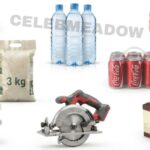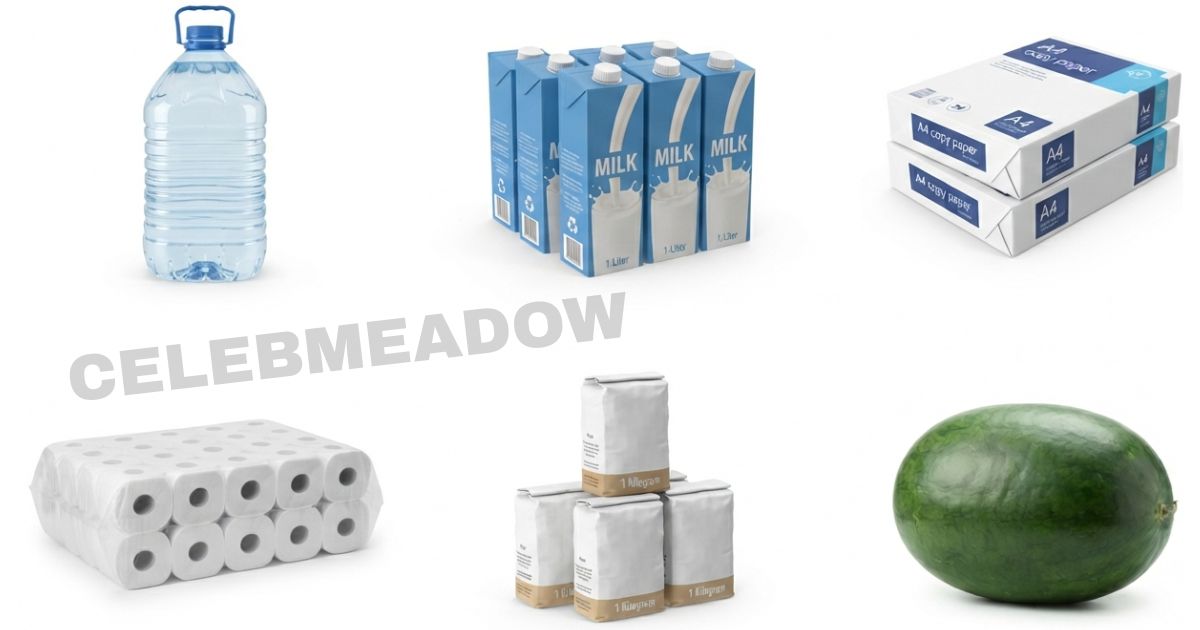
Ordering something online, packing a bag, or checking a luggage limit — the number “5 kg” keeps appearing without any real-world anchor. 5 kg equals 11.02 pounds, or 5,000 grams. It’s a weight you can carry in one hand, but not for long. The ten objects below each reveal something different about what this weight actually feels and behaves like — not just how much it is.
How Much is 5kg? Quick Conversion Chart
| Unit | Value |
| Kilograms | 5 kg |
| Grams | 5,000 g |
| Pounds | 11.02 lbs |
| Ounces | 176.37 oz |
| Stones | 0 st 11 lbs |
10 Real Things That Weigh 5 kg
| Object | Category | Weight | Exact or Approximate |
| 5-Liter Bottle of Water | Grocery / Household | 5.1 kg | Approximate |
| Five 1-Liter Cartons of Milk | Grocery | 5.15 kg | Approximate |
| Five 1-kg Bags of Flour or Sugar | Kitchen / Pantry | 5.05 kg | Approximate |
| Medium-to-Large Watermelon | Fresh Produce | ~5.0 kg | Approximate |
| Large Bulk Pack of Toilet Paper | Household | 4.7–5.0 kg | Varies |
| Cast Iron 5 kg Kettlebell | Fitness Equipment | 5.0 kg | Exact |
| 2-Step Folding Stepladder | Home Tools | 4.8–5.2 kg | Approximate |
| Two Reams of A4 Copy Paper | Office Supplies | 5.0 kg | Exact |
| Commercial Heavy-Duty Blender | Kitchen Appliance | 4.8–5.2 kg | Approximate |
| Solid Oak Dining Chair | Furniture | ~5.0 kg | Approximate |
1. A 5-Liter Bottle of Water
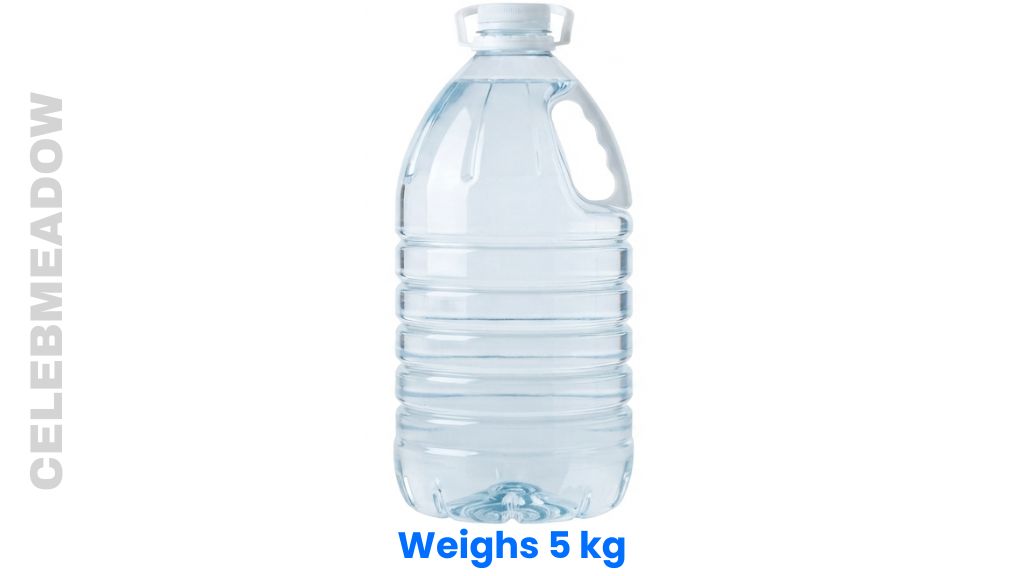
A full 5-liter water jug weighs approximately 5.1 kg — and the handle on it exists precisely because of that weight.
Pure water weighs 1 kg per liter, so five liters alone hits 5 kg. The rigid PET plastic jug and its molded handle add about 100 grams. That handle isn’t a design flourish — it’s an engineering response to this being roughly the heaviest weight most adults can comfortably grip with one hand through a store aisle and into a car.
What this object teaches specifically: 5 kg pulls on your wrist. You feel it in your forearm within 30 seconds. It also has practical value beyond visualization — a standard three-day emergency water supply for one person is about 10 kg, or two of these jugs.
Key measurement: ~5.1 kg / ~11.24 lbs
2. Five 1-Liter Cartons of Milk
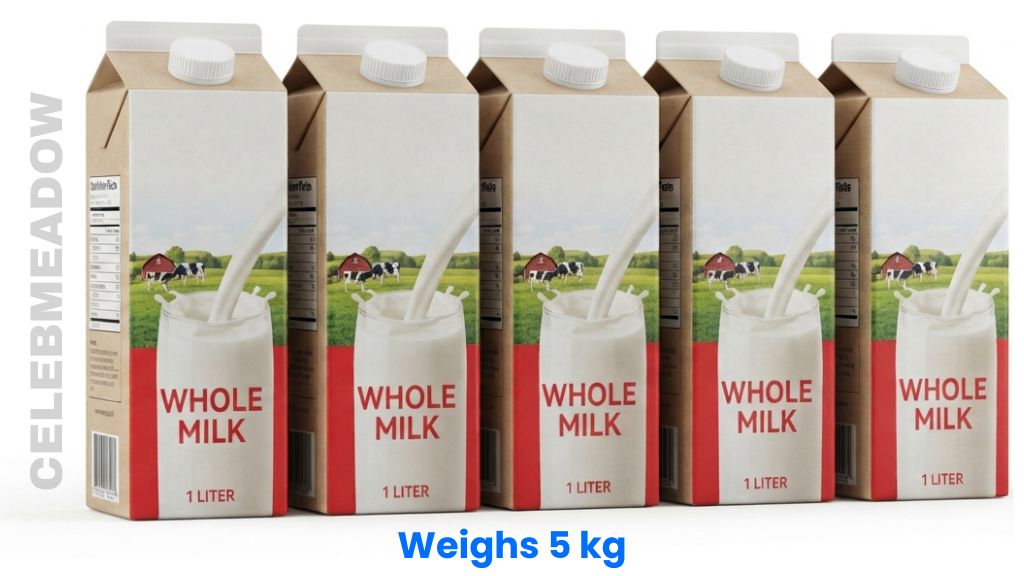
Five standard 1-liter milk cartons together weigh approximately 5.15 kg — and this combination reveals something about how weight behaves in a real grocery run.
Whole milk sits at roughly 1.03 kg per liter — slightly denser than water. Five cartons plus their cardboard packaging lands just above 5 kg. The insight here isn’t just the weight; it’s what happens to it in a bag. Five of these cartons loaded into a single paper shopping bag put the full 5 kg stress onto two small paper handles at the top. That’s the moment paper bags fail. It’s also a useful structural test for glass refrigerator shelves before you load them.
One carton is light and manageable. Five in one arm is the point where most people quietly decide to make two trips.
Key measurement: ~5.15 kg / ~11.35 lbs
3. Five 1-Kilogram Bags of White Flour or Sugar
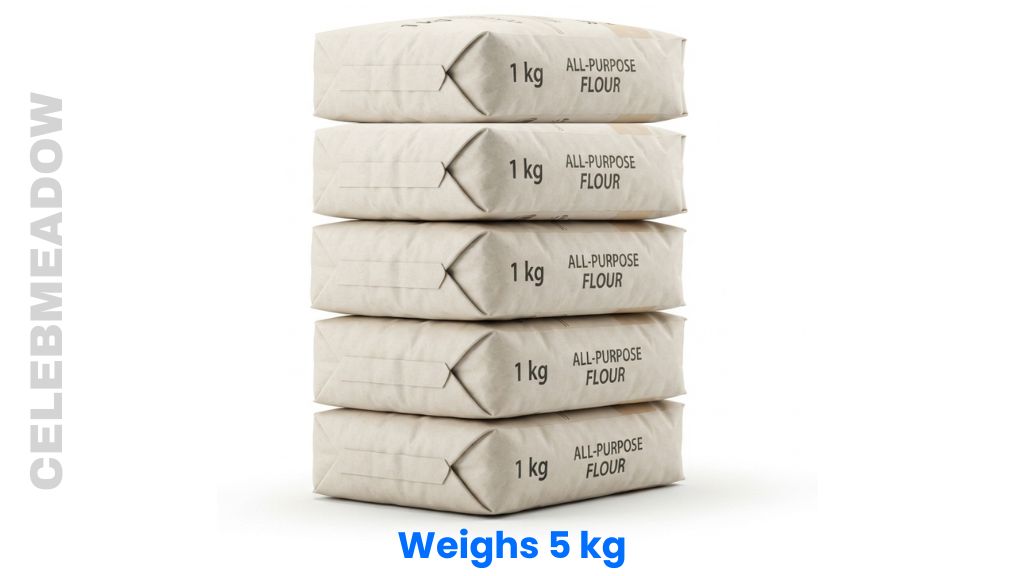
Five standard 1-kg bags of flour or sugar weigh approximately 5.05 kg — and what makes this reference valuable is how the weight feels, not just how much there is.
Each paper sack is a tightly packed, non-shifting block. There’s no liquid movement, no rolling, no air. Stack five and you have a column of pure deadweight that stays exactly where you put it. The paper packaging contributes only about 10 grams per bag — the number is almost entirely dry ingredient.
This is one of the better references for calibrating a kitchen scale. Stack five of these on any scale and you can verify accuracy up to 5 kg without buying calibration weights. The fact that dry goods don’t shift also makes this the clearest comparison for understanding how 5 kg of non-liquid mass distributes on a shelf versus in your hands.
Key measurement: ~5.05 kg / ~11.13 lbs
4. A Medium-to-Large Watermelon
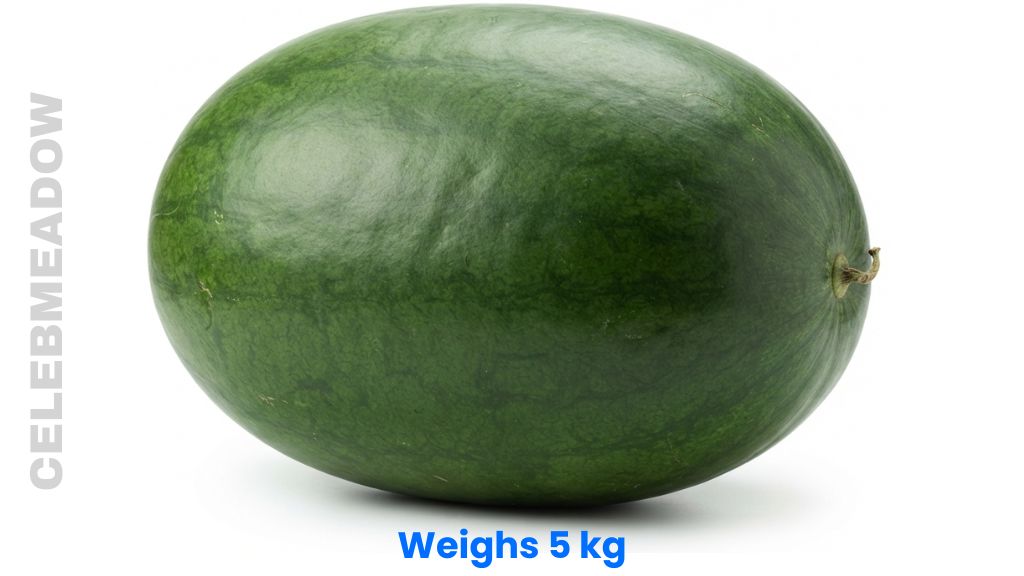
A standard mid-sized grocery watermelon commonly weighs around 5 kg — and it’s one of the most physically honest weight experiences most people have had without ever knowing the number.
Retail seedless varieties are harvested to hit a predictable size range, typically 4.5–5.5 kg. The fruit is roughly 92% water by mass, which explains why something that looks like it might be manageable turns out to demand both hands. There’s no handle, no flat surface, no easy grip — just a cold, round, shifting object that makes you adjust your hold every few seconds.
The watermelon is the object on this list that best demonstrates how shape affects perceived weight. The same 5 kg in a jug with a handle feels much lighter than 5 kg in a smooth sphere. Your brain underestimates it — your arms don’t.
Key measurement: ~5.0 kg / ~11.02 lbs
5. A Large Bulk Pack of Toilet Paper (32–40 Double Rolls)

A warehouse-sized pack of 36 double rolls weighs approximately 4.7 to 5 kg — and it’s the most counterintuitive 5 kg object on this list.
Compressed paper pulp across 36 rolls, plus cardboard tubes and outer plastic wrap, adds up to genuine weight. But because the package is enormous — roughly the size of a small suitcase — the weight feels less than it is when you first pick it up. Within about ten steps, your arms recalibrate.
This object is useful for understanding density versus volume. A 5-liter water jug and a bulk toilet paper pack weigh almost the same. One fits in one hand. The other barely fits under your arm. Both are 5 kg. That gap between how much space something takes and how much it weighs is something this pack illustrates better than almost anything else on this list.
Key measurement: ~4.7–5.0 kg / ~10.4–11.0 lbs
6. A Cast Iron 5 kg Kettlebell
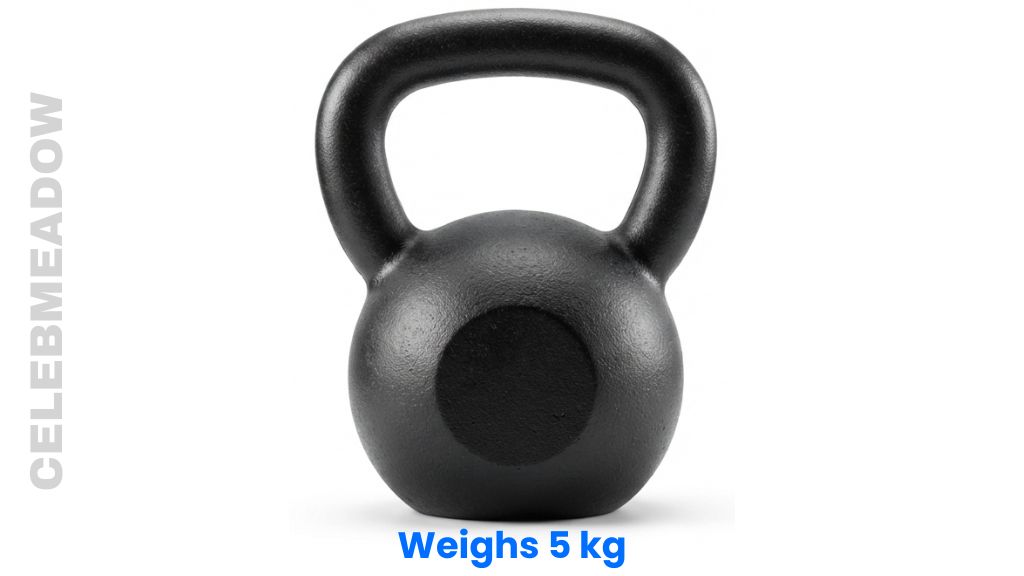
A standard cast iron kettlebell is one of the only objects in daily life manufactured to be precisely 5 kg — with no tolerance for approximation.
Fitness equipment is cast to strict weight specifications because even a 200-gram variance would disrupt a structured training or rehabilitation program. The 5 kg kettlebell is common in physical therapy settings — it’s the standard starting point for post-injury resistance work. The entire mass sits in a dense iron ball, with a thin iron arc as the handle.
What’s unique about this object: the grip geometry changes everything. Lift a kettlebell by its handle and the weight swings slightly forward, loading your wrist differently than a symmetrical jug. The iron is cold and unyielding. It doesn’t flex or compress. At 5 kg, it’s light enough to press overhead but heavy enough that poor form becomes obvious within seconds — which is exactly the clinical value of this weight in rehabilitation.
Key measurement: 5.0 kg / 11.02 lbs (exact)
7. A Standard Metal 2-Step Folding Stepladder
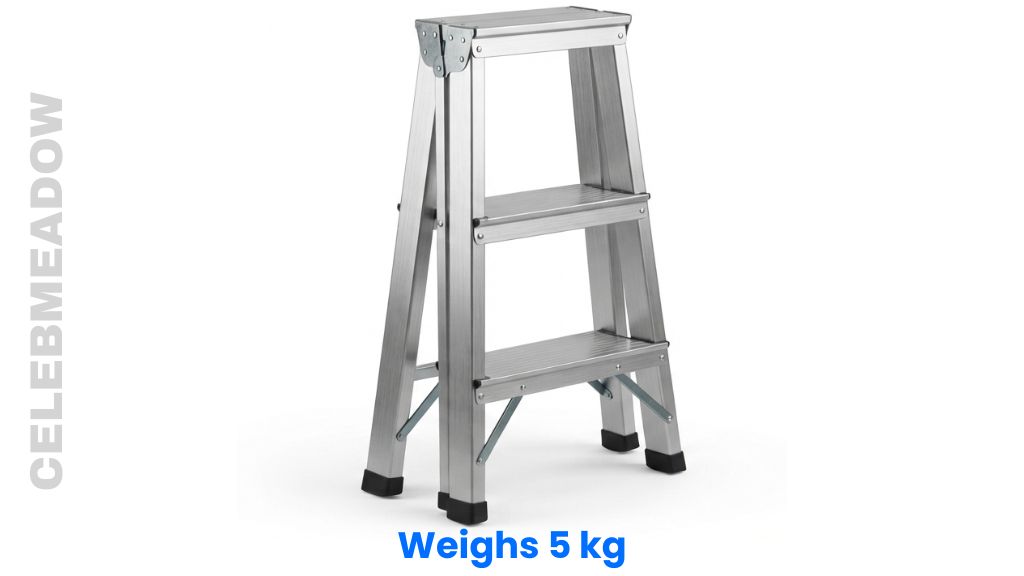
A residential 2-step aluminum stepladder typically weighs between 4.8 and 5.2 kg — a weight calculated to solve two completely opposite problems at once.
It must hold a 100 kg adult without wobbling. It must also be carried single-handedly up a staircase by a lightweight or elderly person without risk of losing balance. Aluminum with steel reinforcement brackets threads that needle, and 5 kg sits right at the center of that design window. Go heavier and it becomes a hazard for smaller adults; go lighter and structural stability suffers.
The carrying experience is distinctive in a way no other object on this list matches. A folded stepladder clanks, shifts, and has corners. The hinges settle unevenly. There’s no comfortable grip position — just a series of compromises as you walk it down a hallway. You’ve done this. You know this weight.
Key measurement: ~4.8–5.2 kg / ~10.6–11.5 lbs
8. Two Reams of Standard A4 Copy Paper

Two reams of standard A4 80 gsm copy paper weigh exactly 5.0 kg — no rounding, no approximation.
One 500-sheet ream at 80 gsm weighs exactly 2.5 kg. This is governed by international paper weight standards, not rounded for convenience. Two reams stacked = 5.0 kg, every time, regardless of brand. The 80 gsm specification exists because it’s the precise fiber density that prevents ink bleed-through in high-speed printers while remaining light enough not to jam feed mechanisms.
Stack two reams on a desk and press down on them. They don’t compress. They don’t flex. The edges are perfectly sharp. This is the most reliable physical reference on this list for verifying whether a kitchen scale, postal scale, or luggage scale is reading accurately — because the weight is guaranteed, not estimated. Office workers, teachers, and logistics managers use this instinctively without realizing it.
Key measurement: 5.0 kg / 11.02 lbs (exact)
9. A Commercial Heavy-Duty Blender

A premium commercial kitchen blender — motor base plus empty pitcher — commonly weighs between 4.8 and 5.2 kg, with almost all of that weight concentrated in the bottom six inches.
The motor base of a machine like a Vitamix accounts for roughly 4.2 kg alone. The empty pitcher adds about 0.8 kg. The base is heavy by design: when a motor spins ice and frozen fruit at over 20,000 RPM, the rotational torque wants to walk the machine across the counter. The weight is the only thing stopping it.
Lift a commercial blender by its base and the weight drops aggressively toward the bottom — nothing like a water jug or a stack of paper. This low, bottom-heavy concentration is how 5 kg behaves when it’s packed into a small footprint. It’s a useful reference before placing a blender on a floating glass shelf or a pull-out kitchen drawer — the load isn’t spread; it’s pinned to one spot.
Key measurement: ~4.8–5.2 kg / ~10.6–11.5 lbs
10. A Solid Oak Wooden Dining Chair
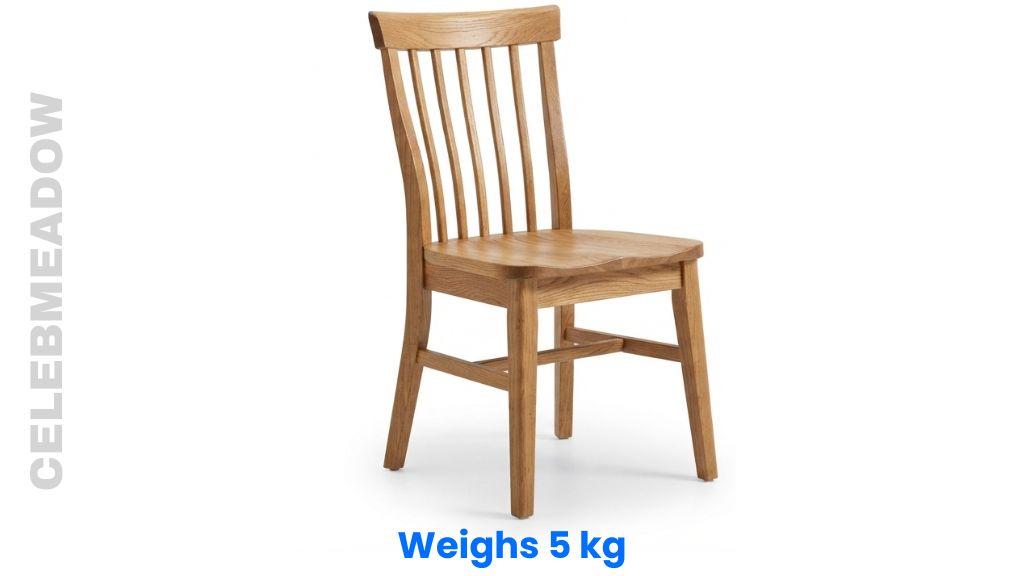
A standard armless solid oak dining chair commonly weighs around 5 kg — and it’s the only object on this list that most people lift daily without thinking of it as “lifting” at all.
Hardwood furniture is built to support adults up to 150 kg without warping or tipping after years of daily use. That structural density is why solid oak at this scale hits 5 kg despite looking relatively light. The wood fibers are compressed tightly — there’s very little air in the material.
The reason this reference works is the gesture, not the object. Pulling a chair out from a table by its backrest with one hand — that tilting, slightly awkward drag — is a 5 kg movement most people have done hundreds of times. No one counts it as exercise. No one thinks of it as “heavy.” But if you pay attention the next time you do it, you’ll feel exactly where 5 kg sits in your arm, wrist, and shoulder. That’s the number made physical.
Key measurement: ~5.0 kg / ~11.02 lbs
How to Picture 5 kg Without a Scale
The most common mistake people make with unfamiliar weights is comparing them to something abstract. A better approach is to compare them to a physical action your body already knows.
Think about pulling a wooden chair out from a dining table — that one-handed drag by the backrest. It’s not quite effortless, not quite heavy. That middle point is 5 kg. Now think about why that matters: luggage limits, grocery loads, shelf capacities. Your body already has this calibrated; you just haven’t attached the number to it yet.
A second reliable method: fill any container to exactly five liters of water and lift it. Water gives you the clearest possible signal because it behaves predictably — 1 liter = 1 kg, always. No approximation, no density variation. Five liters = 5 kg before the container weight. This is why emergency preparedness guides use water volume as their weight benchmark.
The useful thing to know about 5 kg is where it sits on the carrying spectrum. Below 3 kg, most adults carry one-handed without fatigue for several minutes. Above 8 kg, two hands become necessary for most people. At 5 kg, one hand works for short distances — then gradually, your arm starts negotiating.
5 kg Compared to Similar Weights
| Weight | In Grams | Relation to 5 kg |
| 2 kg | 2,000 g | 60% lighter |
| 3.5 kg | 3,500 g | 30% lighter |
| 5 kg | 5,000 g | Target weight |
| 7 kg | 7,000 g | 40% heavier |
| 9 kg | 9,000 g | 80% heavier |
| 10 kg | 10,000 g | Exactly double — two full 5-liter water jugs |
Common Questions About 5 kg
How many pounds is 5 kg?
5 kg equals 11.02 pounds. In ounces, that’s 176.37 oz. A quick mental shortcut: 1 kg ≈ 2.2 lbs, so multiply your kilograms by 2.2 for a fast estimate. Five times 2.2 gives you 11 — close enough for most real decisions.
What is 5 kg in stones and pounds?
5 kg equals 0 stone and 11.02 pounds — written in UK notation as 0 st 11 lbs. It falls just short of a full stone, which begins at 6.35 kg.
What is the most accurate household object that weighs exactly 5 kg?
Two sealed reams of standard A4 80 gsm copy paper weigh exactly 5.0 kg — guaranteed by international paper weight standards, not rounded. A cast iron kettlebell stamped “5 kg” is equally exact, since fitness equipment is manufactured to precise specifications.
How can I use 5 kg as a practical reference without a scale?
Fill a clean 5-liter container completely with tap water and lift it. That’s your baseline — 5 kg before container weight. For a dry reference, stack two reams of A4 printer paper. Both methods give you a repeatable, consistent reference you can use to test postal scales, kitchen scales, or luggage scales at home.
Is 5 kg considered heavy?
It depends on context. For a single grocery item, 5 kg is heavy — it’s the point where most people switch from one hand to two. For luggage, it’s light — most airline carry-on limits are 7–10 kg. For a child to carry, it’s significant. For a trained adult lifting in a gym, it’s a warm-up weight. The number means different things depending on who’s carrying it and for how long.
How does 5 kg compare to 10 kg?
10 kg is exactly double. In practical terms, 5 kg is manageable one-handed for short distances; 10 kg almost always requires two hands or a bag with proper straps. A full 10 kg load is roughly equivalent to a large bag of pet food, a fully packed cabin bag, or two 5-liter water jugs carried at once.
How much is 5 kg in grams?
5 kg equals exactly 5,000 grams. The prefix kilo– always means one thousand, so the conversion is a direct multiply or divide by 1,000 — no formula needed.
Pick any two or three objects from this list and you’ll have a permanent, reliable sense of what 5 kg means in your body. A solid oak chair pulled from a table, two reams of paper pressed flat, a watermelon carried with both hands across a parking lot — these aren’t just comparisons. They’re weight experiences you’ve already had. The number was always there. Now you know what it’s called.
Read More Measurements Guides:

I’m Cherry Sin, and I write clear, practical guides that help people understand everyday measurements and sizes. I focus on turning numbers into easy mental pictures using familiar objects and real-life situations. At Celebmeadow, I write guides that explain measurements in a simple, visual way.